Thursday, August 1, 2013

Evolution of the Community Garden at South Branch Preserve

Along with our restoration work at South Branch Preserve, The Land Conservancy of New Jersey has constructed a community garden North Section of the Preserve located along Wolfe Road near Route 46 East.  The garden is laid out in a grid with wood chip paths separating the garden plots.  Gardeners have purchased plots and planting crops of their choice.  The Land Conservancy has been working hard for several months to have the garden up and running in time for the spring growing season.  Of the 140 plots, 78 have been purchased and cultivated, and 62 are still available for purchase.  Here is a behind the scenes look at each phase of the garden construction until its current appearance.


The first step in the process was to obtain approval from the Mt. Olive Township Planning Board.  This involved creating a detailed site plan showing the location of the parking lot, garden, and well.  In order to keep the disturbance of the area to a minimum, the parking lot was constructed on the former site of the farmhouse and barn previously located on the property.  The parking area was covered with gravel and lined with logs rather than being paved to provide a more permeable surface. 


The garden’s location was determined by the power lines that run across the property.  Originally the garden was planned to be adjacent to the parking lot but was moved further away, to avoid disturbance to the power lines. 


Once the location of the garden was laid out, a shed was purchased to store the tools for the gardeners and The Land Conservancy staff. 


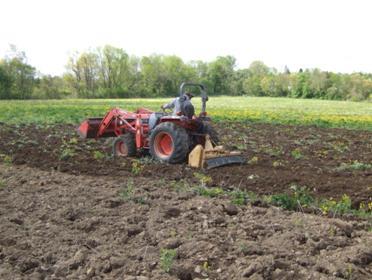
Once the shed was placed on the site, the soil was tilled and plowed to prepare the plots for planting.


After the soil was tilled a metal fence was erected around the perimeter of the garden, with rabbit fencing placed on the lower parts of the fence.  The rabbit fencing has a tighter weave than the metal fence in order to keep small rodents from making their way into the garden. 


While work was being done on the inside of the fence, a 422 foot well was dug outside the fence that pumps 25 gallons of water per minute.  Once the well was dug, electrical lines were installed to provide power to the pump. Water was now onsite for the gardeners!


Ten foot square plots were measured and laid out in the garden, the paths vary from 2 to 3 feet between the garden plots.  With the plots measured and laid out, irrigation ditches were dug to install pipes and spigots throughout the garden. 


The paths and the area around the shed were mulched and a 325 foot walking path connecting the parking lot to the garden was laid out and covered with wood chips.

All of this work was completed by May 25  for the opening of the garden.  Work on the garden continues throughout the growing season to ensure the pathways and garden plots remain free of weeds for gardeners and visitors.    


o
Aerial Photographs: Credited to the Musconetcong Watershed Association

Wednesday, March 20, 2013

Repairs Completed After Hurricane Sandy Downs 100 Trees within the South Branch Restoration Site


After moving along most of the Atlantic Coast as a Category 1 storm, Hurricane Sandy made landfall in New Jersey on October 29, 2012. It was the second costliest hurricane in the United States, following the infamous Hurricane Katrina that devastated New Orleans. Coastal towns of New Jersey were subjected to quickly rising tides and severe waves generated by the storm, and the interior of the state dealt with the strong and violent winds of the storm. Across many towns, downed trees resulted in serious and dangerous damage to both property and the power grid.

Upon inspection of the South Branch Preserve Restoration Site in Mt. Olive, we discovered over 100 trees fell, many landing one on top of another, with over a third of these trees crushing portions of the deer exclosure fencing surrounding the Restoration Site. Fallen trees can be beneficial to the property by promoting new growth and habit for many species. But, loss of the fence’s integrity placed the new plantings and sensitive native flora at great risk of loss by deer over-browsing. The exclosure fence protects the native plantings and allows the understory a chance to thrive and create a healthy forest.
Removing the trees and repairing the extensive damage to the exclosure fence was going to be an arduous task that would take time. Time we did not have, only a few days after the storm, deer tracks could already be found inside preserve. The Budd Lake Hilltop Rod & Gun Club quickly agreed to help and by mid-December had cut and removed the trees so the fence could be repaired. Staff carefully re-hung the damaged fencing and the Dodge Foundation generously provided financial support to purchase replacement fencing and materials. The exclosure fence repairs have been completed and deer are once again restricted from the site. The absence of deer as well as the increase in microhabitats from the downed trees will improve the health and diversity of the flora and fauna of the area.

Wednesday, December 12, 2012

Fifth and Sixth Properties Added to South Branch Preserve, Mt. Olive Township

The Land Conservancy of New Jersey is pleased to announce that they have closed on two properties totaling 18 acres to be added to The Land Conservancy’s South Branch Preserve in Mt. Olive Township.  These are the fifth and sixth properties to be added to the Preserve since its establishment in 2010.  Purchased in partnership with the Morris County Municipal Utilities Authority, these properties adjoin the South Section of the Preserve located at the end of Shop Lane and its intersection of River Road in the Township.  The Morris County Utilities Authority and New Jersey Water Supply Authority is working with The Land Conservancy on four projects; these are the first two to be purchased. 


“The Land Conservancy of New Jersey is delighted to have closed on these properties,” states David Epstein, President of The Land Conservancy.  “We thank our partners, the Morris County Municipal Utilities Authority and the New Jersey Water Supply Authority, for their participation in these projects.  In addition, we wish to recognize the ongoing support of Mt. Olive Township to protecting the headwaters of the South Branch of the Raritan River, a drinking water supply source for over 1.5 million New Jersey residents. We hope this project will inspire our state, county and local agencies to continue to fund these important preservation initiatives to ensure our water resources remain secure and plentiful.”

“The Morris County Municipal Utilities Authority is pleased to be a partner in the protection of these properties which add to the South Branch Preserve,” explains Glenn Schweizer, Executive Director of the Morris County Municipal Utilities Authority.  “The Preserve is an important water management resource in Morris County consisting of headwaters to the South Branch Raritan River Watershed which provides drinking water for many in Morris County and New Jersey.”

The South Branch Preserve now totals 390 acres. The North Section (totaling 208 acres) is located immediately below Budd Lake at the intersection of Wolfe Road and Route 46.  The South Section is 182 acres and incorporates this newly preserved property.

South Branch Preserve:


In partnership with Morris County Municipal Utilities Authority, Mt. Olive Township, New Jersey Water Supply Authority, Trout Unlimited, Raritan Headwaters Association, and New Jersey Green Acres, The Land Conservancy has worked to protect the watershed lands surrounding the South Branch of the Raritan River, a drinking water supply source for over 1.5 million New Jersey residents. The South Branch Preserve is a great example of efforts to bring together public and private organizations with different interests and resources to preserve lands of regional and statewide significance. The long term vision is to increase the South Branch Preserve to 1,000 acres to serve as a showcase for watershed preservation and restoration; organic farming, a community garden, and resource-based recreation including fishing and hiking.


Located in the headwaters of the South Branch of the Raritan River at Budd Lake, the South Branch Preserve is a remarkable watershed containing scenic views, rich forests, tilled agricultural fields, diverse wetlands, and unique riparian corridors. The South Branch of the Raritan River flows into the main stem of the Raritan River, which is the largest river basin located entirely within the state New of New Jersey and is one of its most critical water supply sources.

The Land Conservancy and its partners have added five properties to the Preserve, which now totals 390 acres and includes three-quarters of a mile of the river flowing through the Preserve. The Land Conservancy continues to focus its efforts on the preservation of the watershed of the South Branch of the Raritan River. Far reaching plans are being developed for managing the South Branch Preserve property to ensure it protects the South Branch of the Raritan River and provides for public enjoyment.

Tuesday, September 4, 2012

South Branch Preserve Update 3: Birds and Wildlife

Entrance Gate
     Every time we pay a visit to our South Branch Preserve Restoration Site we keep spotting more species of birds, butterflies and amphibians. I decided to conduct a breeding bird survey inside the 100 acre fence on June 21, 2011. I walked from the entrance gate, down Shop Lane to the end of the cul-de-sac, through the forest, across the main stream and down Yalda Court back to the main gate. I walked this entire loop from 6am to about 7am. As I walked this route I counted all of the birds I saw or heard on the entire walk.

Shop Lane
This route will be completed in the same manner each year. On this first year’s walk I ended up spotting or hearing 30 species of birds and 85 individuals. Catbirds were the most plentiful bird spotted with 11 individuals. There was a three way tie for the second most individuals seen. They were six each of the following species, the beautiful red/orange scarlet tanager, the ground loving ovenbird and a flycatcher called the eastern wood-pewee.
Three uncommon hairy woodpeckers were spotted as well as its larger cousin the pileated woodpecker. One threatened species was seen called a Cooper’s hawk  which may nest on the property or an adjacent property.


     The information from this survey will be used to monitor the changes in the bird populations of the site as restoration of the forest continues. This survey will help us determine what bird species favor the site. We suspect that when the understory re-establishes itself in the future there will be an increase of ground nesting bird species. Right now our ongoing total bird list for this site stands at 51 species.

Great Spangled Fritillary Butterfly
     A total of twenty-one species of butterflies, have been identified at South Branch Preserve Restoration Site as of fall of 2011. During the summer & fall they were spotted feeding on the flowering native plants that grew from the many species of wildflower seeds that were planted on the site in the summer of 2010. They were also observed feeding on the native plants that were already growing onsite.
Great Lobelia at the South
Branch Preserve

This site is blessed with an abundance of frogs as evidenced by the frequent visits from the great blue herons. One week after the vernal ponds were created American toads produced their egg masses in several of the vernal ponds. One week later these eggs hatched and thousands of tadpoles were seen swimming around in the shallow waters.

Green frogs and tree frogs are numerous as well and breed onsite. Twice we have spotted box turtles on the site. Three species of snakes have also bee observed, they are garter, water & brown snake. Five species of salamanders were found so far on the site. Many were spotted under the hay bales that are used for erosion control.
Green Frog
     Conventional wisdom suggests that if an amphibian population is thriving, the area is probably clear of pollutants. This is true at our restoration site. A lot of the water starts right on site from seeps and springs and it is near the top of the mountain at around 1000 feet above sea level.
     
Twice a red fox has been spotted inside the fence. Evidence of black bear, (claw marks on a tree and scat) & coyote (scat) has been seen outside of the fence. We are keeping an ongoing list of the wildlife that is seen on the site so our list increases with every season.

                                                                    Dennis Briede
                                                                    Stewardship Manager

Wednesday, May 9, 2012

South Branch Preserve Update Two - Erosion Control


The restoration of the South Branch Preserve property by The Land Conservancy of New Jersey was started after the purchase of the property in May of 2010. The previous owner had constructed 2 gravel roads, 8 stream crossings, 2 storm water catch basins and was ready to construct 16 new homes there. The Land Conservancy developed a plan to restore the site back to forest by a strict September 30th deadline, as per DEP rules.
 
During the restoration process 14 various sized vernal type ponds were created,


the roads were covered in several inches of soil, 


and the stream crossings were re-created to act like natural stream crossings. 


Soil was spread in the disturbed areas and native warm season grasses and native wildflower seed were planted.


A 100 acre fence was erected to surround this area and keep the deer out.  This fence will help the 1280 various trees, shrubs and perennials that were planted on the site to flourish.  


After a very wet fall, extremely snowy winter (over 80 inches of snow fell), and a wet spring, many of the seeds started to sprout and fill in the areas, with almost all of the trees, shrubs, and perennials surviving the harsh winter. Once the soil really warmed up in late May the grasses, wildflowers and other flora took off in a growing spurt through August.


This helped to reduce most of the erosion problems that may have occurred during restoration.

On June 28, 2011 the original restoration crew from Paul Steinbeiser Inc. along with several employees at The Land Conservancy worked at the site to minimize the erosion problems, bringing in only light machinery to reduce disturbances to the new plant growth. The machinery was used to reduce some of the erosion that was forming near several of the streams that flow through the preserve. Several areas were raked, re-seeded and covered with a light layer of straw to quickly establish a groundcover.

Over the next two months many of the annual oats grew tall and many of the perennial seeds had sprouted and were in bloom. Luckily the lush growth of these plants greatly reduced the chances for significant erosion that would have been caused by the four intense storms from the period of Mid-August through September. More plans are in the works to continue to monitor and help control any future erosion problems at the site.


Dennis Briede

Stewardship Manager

Monday, April 30, 2012

South Branch Preserve Update One - Invasive Species Removal

In New Jersey as well as the rest of the United States the influx of non-native plants & invasive non-native plants has significantly increased in the past two centuries. Non-native plants are plants that were not originally found in the United States but are now established here. Most of these plants arrived here by airborne pollen, machinery, animals, humans, or other means; often originating from Europe or Asia.

Of the hundreds of non-native plants there are close to 200 invasive non-native plants in New Jersey alone. These invasive non-native plants are very aggressive in their colonization and since they have no natural insect enemies will spread quickly and profusely. When ignored, these plants will aggressively spread throughout large areas and will dominate over the native species reducing their populations. Efforts have been made to help reduce the impact that these plants have on the native flora and fauna.

We have found many of these plants at our restoration site in Mount Olive. Due to the high diversity of native plant species at this site it is very important to reduce the invasive plant population. A thorough mapping of these non-native invasive plants was performed by plant expert Michael VanClef from Ecological Solutions, LLC.

On May 31st plans were made to start the eradication of some of these plants before they spread throughout the preserve. Mike VanClef, three Land Conservancy of NJ interns and Stewardship Manager Dennis Briede went to the site and selectively applied an herbicide designed to eliminate these plants. Since then they have eliminated two of the species, Japanese Aurelia & Chinese silvergrass & reduced the Japanese barberry, ailanthus, mugwort, winged euonymus & autumn olive from some of the areas.


Keep an eye out for invasive non-native plants in your yard:


Japanese barberry,

autumn olive,
multiflora rose,


phragmites,

Chinese silvergrass,

and Japanese Aurelia


These plants, along with many others have spread throughout many parts of New Jersey as well as other areas of the United States.


see the website below for more information, on how to identify them and their native look-alikes:
http://www.nybg.org/files/scientists/rnaczi/Mistaken_Identity_Final.pdf

Friday, April 6, 2012

Pedal for Preservation on June 3rd!

Don’t just ride…pedal to preserve the best of New Jersey!

Get your heart pumping and feet pedaling for a great cause on Sunday, June 3rd as The Land Conservancy of New Jersey (TLC-NJ) hosts its first Pedal for Preservation Bike Event. Participants will ride on the Columbia Trail, a Rail to Trail route that is known as one of the most beautiful rides in New Jersey. Riders will start and finish at West Morris Central High School, 259 Bartley Rd, Chester, NJ.

Registration for the event is now open. Sign up by 4/30/12 and take advantage of the early registration discount!

“This family friendly off-road biking experience is geared towards riders of all biking abilities. The day will feature good food, a great ride, and fun for everyone, says Conservancy President David Epstein. “Best of all, riders will be pedaling to preserve the best of New Jersey -- the beautiful natural lands that are so special to us all!” Proceeds from Pedal for Preservation will help fund The Land Conservancy of New Jersey’s land preservation work.

Become a Champion for Open Space and team up with TLC-NJ by participating as a rider, team member, sponsor, donor or volunteer. Pay a flat registration fee or help fundraise by getting friends and family to sponsor your ride. Registration on the day of the event begins at 8am.
To register online:http://www.active.com/cycling/chester-nj/the-land-conservancy-of-new-jerseys-pedal-for-preservation-the-columbia-trail-2012

For mail-in registration or to learn more visit www.TLC-NJ.org

Volunteers are also needed. To volunteer contact Rosalie Lavinthal at rlavinthal@tlc-nj.org and to make a donation http://www.active.com/donate/tlc-nj.

Don’t just ride…Pedal for Preservation!!