Tuesday, July 12, 2011

THE WORLD SERIES OF BIRDING RESULTS
by Dennis Briede Stewardship Manager
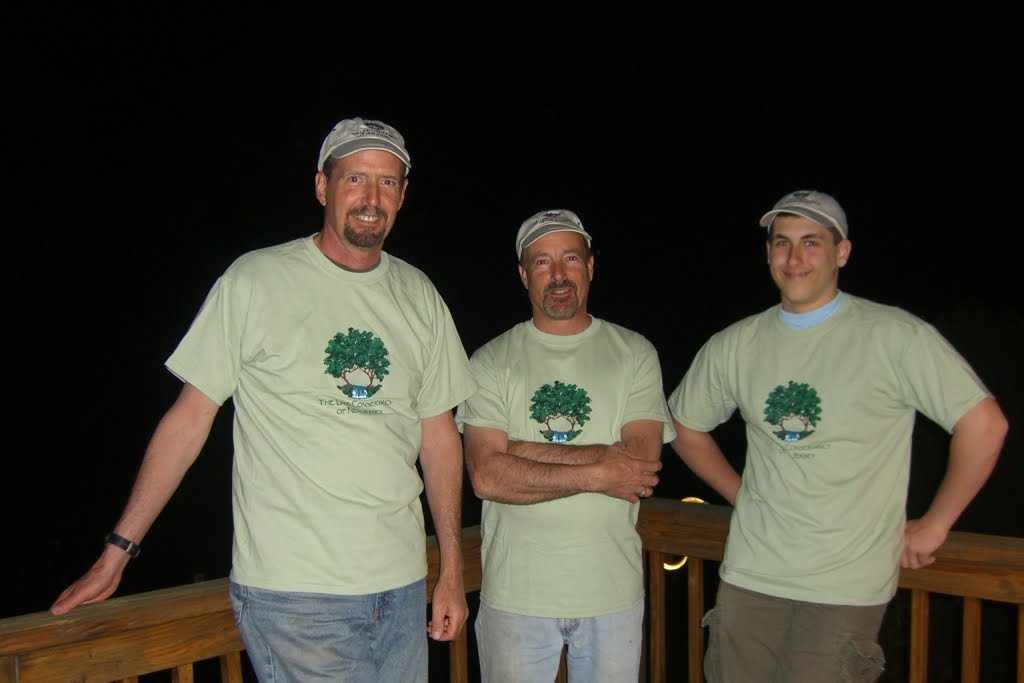
It was a minute before midnight of the big event. The gas tank was filled. The coolers were packed with food & drink. Our team The Highlands Hawks consisting of Alan Boyd, Stephen Kloiber & I were well rested & ready to go. It was time to begin the 2011 World Series of Birding. It was dark, cool & cloudy.

We started at midnight in Blairstown (Warren County) where we managed to get our first bird, the Whip-poor-will calling in the pitch black night up on Catfish Mountain. Avoiding the skunks, opossums, raccoons and deer crossing our car’s path we then headed to the marshes & swamps of Sussex County to hear other night birds such as rails, owls & bitterns. We managed to get a rail, an owl but no bitterns. A few other birds were also calling such as geese, sparrows and a turkey.

We then spent dawn in the Wantage Grasslands of Sussex County listening for the open farm & grassland birds such as bobolink, savannah sparrow, orchard oriole & kingbird. The next 3 hours were spent winding through and stopping at the many productive spots in the deep wilds of High Point State Park & Stokes State Forest where we added hawks, warblers, vireos, woodpeckers & thrushes.

At 9:30 am we then left the forest and headed south on Rt 206 to an old sandpit north of Newton where we added indigo bunting, swallows and a kingfisher among others. After a 2.5 hour ride south we stopped at the Forsythe National Wildlife Refuge known as Brigantine where we added a bunch of birds such as terns, ducks, gulls, sandpipers, herons & egrets. Our list was growing.

Our next stop was Belleplain State Forest in Cape May County. There we added the beautiful summer tanager and the blue grosbeak among others. From there we visited several of the parks near the beaches of Cape May and got many more shorebirds such as sandpipers, plovers, terns & gulls.

As evening approached the wind picked up so we were not able to hear any more night birds. It was time to call it quits after driving over 600 miles. We then checked in to the meeting place where we got a round of applause from the crowd. I found out later that all participants entering the meeting place got a round of applause.


We ended up with 151 species of birds which was 7th place in the entire state category and 11 place overall out of 64 teams. In order to take on such an endeavor as The 24 hour World Series of Birding one has to not only be awake for more than 24 hours but also be sharp enough during the entire time not to miss any bird calls. When it was over we slept very soundly that night.

We at the Land Conservancy of New Jersey would like to say thank you to all who pledged dollars for this event. Because of the generosity of all of our donors we raised over $14,000 toward our land preservation efforts. Now you get a round of applause.


Thursday, June 23, 2011

162 acre Weber tract preserved in Kinnelon Borough


6/23/2011


Weber tract preserved, newest addition to the Morris County park system


A 162 acre Weber Tract in Kinnelon Borough has been preserved in a partnership with The Land Conservancy of New Jersey, Morris County Park Commission, Morris County Board of Chosen Freeholders, and the State of New Jersey. This property is the culmination of a multi-year effort to protect this critically situated land in the New Jersey Highlands.


The Borough will own 100 acres of the property for recreation (for hiking and bird watching) and natural resource protection and a 62 acre portion of the land will be added to Morris County’s Silas Condict County Park. Located within the New Jersey Highlands Preservation Area, this site features steep slopes, scenic ridgelines, bluffs and wetlands.


The property is located on Maple Lake Road, near Route 23 and Kinnelon Road. Its mountainous terrain affords exceptionally scenic views of the surrounding landscape. This land will become part of an interconnected greenbelt that extends north from the Silas Condict County Park into neighboring West Milford Township. This property provides habitat for a diverse collection of species on the federal and state threatened and endangered species list. Protecting this land prevents fragmentation of the forested landscape which is one of the greatest threats to New Jersey’s wildlife habitat.

Monday, April 18, 2011

The World Series of Birding

by The Conservancy's World Series of Birding Team Captain, Dennis Briede


The World Series of Birding was established by the New Jersey Audubon Society in 1984 to help raise money for conservation. Since its inception the participants have raised a combined total of nearly $10,000,000. The Land Conservancy of New Jersey raises $16,000 - $20,000 each year through the support of our members for our World Series of Birding team. Every species found, every dollar raised preserves & protects critical bird habitat in New Jersey.


In 1984 there were only 13 teams. Now there are over 50 teams in every category. The objective of the day is to tally as many bird species as you can in a 24 hour period. This can be done by bicycle, boat, car, foot, in one county, in one spot (a deck) or a group can cover the entire state of New Jersey. You need to be skilled not only in the identification of about 200 species of birds; you must also know their songs and calls. A good majority of the bird species during that 24 hour period are heard and not seen (yes even in the dark!) You have to remain sharp for 24 straight hours if you want to tally 150 plus species for the day.


This is the 15th year in a row that a team from The Land Conservancy of New Jersey has participated in the World Series of Birding. Our Highlands Hawks team consists of Captain Dennis Briede (Conservancy Stewardship Manager), Alan Boyd and Stephen Kloiber. Dennis and Alan have been birding since 1980. Stephen is an exceptional birder and is only 18 years old. He joined the team last year and has been birding with Alan and Dennis for nearly a year.


It’s best to have a team that is familiar with each other because the team will be together from 10:00pm Friday night until 1:00am Sunday morning (27 hours or so). We will even eat in the vehicle between stops (cooler provided). Toyota/Lexus has been kind enough to lend the Conservancy a vehicle for the event. Last year the team drove over 600 miles by the end of the day. It is a fun event but at the same time it is very grueling.


The most important key is the route. Most of the really high scoring groups start in north Jersey and end up at Cape May by midnight. Usually the groups start out visiting swamps and wetlands from midnight until about 5:00am to hear the wetland birds such as bitterns, rails and ducks. Scouting is needed to find nesting hawks and owls. At dawn you need to find a place with diverse habitat to tally all of the various birds singing and calling in the early hours. From there you visit special spots that are host to some of the uncommon and more difficult species to find. Our team’s goal this year is to be on our way to south Jersey by 9:30am or there won’t be enough time to visit all of the special spots in that area. All teams must either email the results or report to the final meeting place by midnight or be disqualified.


Please help our Highlands Hawks team raise money for The Land Conservancy of New Jersey’s land preservation work. Please donate any amount you can. You can make a per-bird pledge online here (for example, $1 per bird). Our goal is to tally 200 species or more!

Friday, March 4, 2011

SIGNS OF SPRING: A Series by Dennis Briede, Staff Naturalist

We want you to know what is going on in the world of nature at this time of year as well as some news about The Land Conservancy of New Jersey. Most of the time we are so busy traveling from work to home, or school to business, that we don’t see what is going on in the world of around us, the world of nature, that we are all working so hard to protect.

At this time of year we are still in the wrath of this snowy winter but there are already many signs that spring is just around the corner. If you have a view of a forested or a wet, swampy area take a closer look at it and you will notice that the trees have taken on a reddish hue. That means that the buds are swelling, in anticipation of spring. This is especially true of the maple trees. In about three weeks they will be blooming! Another sign that spring is just around the corner is the song of the cardinal. In the early morning they are starting to whistle their clear melodious song. Some of the other local birds that are easily seen this time of year are the morning dove and the tufted titmouse, who are also starting to sing.

You can also hear the drumming of the woodpeckers in the forest outside your window. Just like bird songs, drumming is most common in spring when birds are trying to attract mates and establish territories. Sometimes they will pick a rain gutter to hammer away on and it sounds like a machine gun going off right outside your window. Great horned owls are already sitting on their eggs and the bald eagles are ready to nest. Small flocks of redwing blackbirds and common grackles are gathering and will soon disperse to find their nesting sites. You can hear them chattering away in the trees. Turkey vultures as well as black vultures are moving north in the skies above us. Crocuses & snowdrops have pushed up from the ground and soon will be flowering. Maple sap is starting to flow. You can sometimes see it hanging on a branch like an icicle. Small brown moths are already flying around in the warmer evenings.

Keep your eyes and ears tuned in the next couple of weeks for more sights and sounds of spring. The skunk cabbage will be blooming and woodcocks will be arriving and displaying their mating rituals in the wet fields. The two common overwintering butterflies, the comma and the mourning cloak, will be seen fluttering outside. Spring peepers will start to call from the swamps and wood ducks will be arriving in the local lakes and small open areas. So even if we get more snow and cold spring is coming. Stay tuned.

Monday, January 31, 2011

Scholarship applications available now

1/31/2011

The Land Conservancy of New Jersey is accepting applications for their 2011 Scholarship Program.
The Conservancy administers two major Scholarships, the Russell W. Myers Scholarship and the Rogers Family Scholarship. The Conservancy’s Scholarship Program will be awarding a total of $14,000 in 2011. Each Scholarship will provide $7,000 to a New Jersey resident pursuing a degree in environmental science, natural resource management, conservation, horticulture, park administration, or a related field. Potential candidates must currently be a student in good standing with at least 15 credits completed and have an academic average equivalent of a 3.0 or higher.

The deadline for application is April 1, 20110. One application covers both Scholarships. Interested students can obtain application forms by calling The Land Conservancy at (973) 541-1010 or by visiting our website at http://www.tlc-nj.org/.

The Russell W. Myers Scholarship Fund was established in 1983 to honor Mr. Myers, founder of Morris Land Conservancy, and an outstanding leader in the field of conservation. Mr. Myers served as the first Director of the Morris County Park Commission for more than a quarter century. His dynamic leadership established the Morris County Park System as the largest county park system in the State of New Jersey and one of the finest in the nation.

The Rogers Family Scholarship Fund was established in 2005 by Gray and Mollie Rogers, dedicated conservationists who wanted to expand The Land Conservancy of New Jersey’s educational support for outstanding environmentally-oriented students. Gray Rogers is a Trustee Emeritus of the Conservancy.

The Land Conservancy of New Jersey’s Scholarship Program has awarded $148,000 in grants to 40 outstanding college students since its inception.

55 Acres Preserved in Hardwick Township


Warren County: 55 acres preserved in Hardwick Township
Check out this great project that was completed late in December:

The Land Conservancy of New Jersey is pleased to announce the preservation of a 55 acre property near the intersection of County Road 521 and Spring Valley Road in Hardwick Township on December 7, 2010. Previously owned by John Eric Wehrle of Hardwick Township, the site is a mixture of farm fields and forest located near the Township municipal complex. The property provides an important opportunity for recreation and its preservation is consistent with Hardwick Township’s Open Space Plan which sets a priority for protecting environmentally sensitive sites that can host rare and endangered species.

The site - which is made up of four parcels of land - was ripe for sale and development. When one of the parcels went up for sale two years ago, local officials worked with The Land Conservancy of New Jersey to purchase the property for open space. Located within an area known as “Spring Valley,” this corner of the municipality contains several large springs fed by underground streams. Its preservation protects Ridge and Valley Conservancy’s (RVC) adjoining Spring Valley Preserve. Ferlas Pond, a vernal sinkhole pond that hosts several rare species, is located on the Preserve. Vernal ponds are intermittently filled with water, going through cycles of drying out and filling up with water, particularly after rains or when snow melts. Since they almost never contain fish, they are an ideal breeding ground for frogs and other amphibians. A similar sinkhole pond is located on the Wehrle property.

The property will be owned by the Township of Hardwick. It was purchased using Warren County Open Space Funds, municipal Open Space Funds, and a grant from the New Jersey Green Acres program. The site is the first open space project Hardwick Township has preserved with The Land Conservancy of New Jersey. Combined with three farms preserved by The Land Conservancy and Township a year ago, the Conservancy has helped Hardwick preserve 402 acres of land within the municipality.

A hiking trail that begins at town hall runs through the RVC Spring Valley Preserve. This trail will be extended into the Wehrle property, following tractor lanes within the property. The expansion of the trail will give residents access to the property’s serene and beautiful plateau and allows viewing of the wildlife that is found within Spring Valley.

Monday, November 22, 2010

Plantings critical in restoring the natural state of the South Branch Preserve


While the physical restoration of the South Branch Preserve may be complete, ongoing monitoring of the property is now critical. When the site was altered for residential development, many plants and trees were destroyed. These have now been replanted on the site, helping to bring it even closer to its pre-development state. Several steps are being taken to ensure they take root and survive onsite.

Some new plant growth on the South Branch Preserve Restoration Site

Among the trees and shrubs planted are Sugar Maples, Red Maples, Black Cherry, Silver Dogwood, Beardstongue, and Swamp Milkweed. In total, over 300 trees and over 700 shrubs were planted throughout the South Branch Preserve Restoration Site. Given some time to grow, the forest will be on the rebound within five to ten years!

Bowman’s Hill Wildflower Preserve has completed a Plant Stewardship Index (PSI) for the site. The PSI measures the ecological integrity of native plant communities and establishes a standardized measure of the effectiveness of our land management practices over time. The PSI was conducted by a team of botanists inventorying each of the plant communities on the site. The final report shows that the South Branch Preserve Restoration Site has one of the highest diversities of plant species inventoried in New Jersey.

While the new plantings begin to grow, it is also important to keep an eye on the spread of non-native species on the site. These “invasive” plants thrive on disturbed sites, making it more difficult for native plants to survive. The Land Conservancy’s Stewardship team is working with our restoration experts to provide every opportunity for native saplings, seeds, and shrubs to thrive.

An Invasive Species Report by Ecological Solutions found that two of the most pervasive non-native species at the South Branch Preserve are Japanese Stiltgrass and Japanese Barberry. Deer and other animals tend to avoid these plants in favor of native species, further encouraging their spread. Each of these species can be found on nearly half the acres in the 135-acre site. In total, twenty non-native species are present on the site.

This map shows the extent of non-native species present in different areas of the South Branch Preserve site.